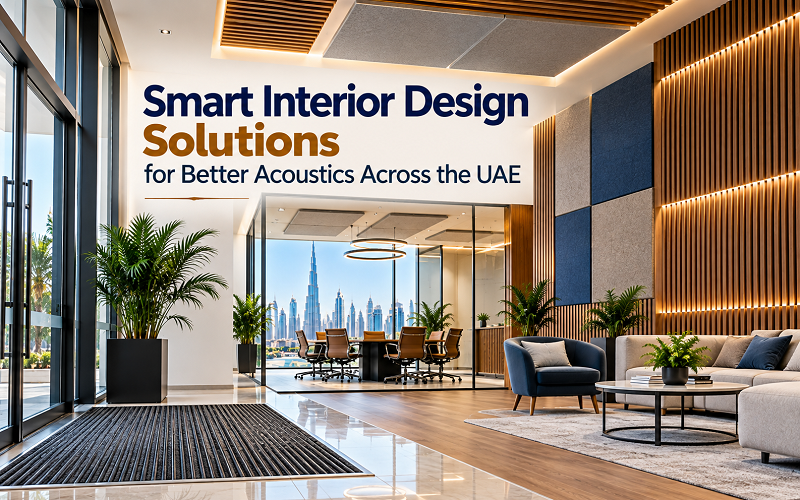
Smart Interior Design Solutions for Better Acoustics Across the UAE
Modern buildings across the UAE often feature glass partitions, tiled floors, concrete walls, and open layouts. While these materials create attractive interiors, they can also contribute to unwanted noise, echo, and poor speech clarity. Offices may become distracting, restaurants can feel excessively loud, and residential spaces may lack acoustic comfort.
Choosing appropriate interior materials helps address these challenges without compromising the appearance or functionality of a space. Wooden acoustic panels, felt wall treatments, floor underlays, and entrance mats each serve a different purpose. Understanding their performance and installation requirements allows architects, contractors, facility managers, and property owners to make informed decisions.
This guide explains how to select these materials for practical applications, with a focus on acoustic comfort, durability, and interior design across the UAE.
Sound Proofing Wood Panels Dubai: Combining Design and Acoustic Comfort
Wooden acoustic panels offer a practical way to improve room acoustics while maintaining a natural, architectural finish. They are commonly considered for boardrooms, hotel interiors, restaurants, residential living rooms, and reception areas.
When evaluating Sound Proofing wood Panels Dubai, it is important to understand how these products work. Many acoustic wood panels feature slatted or perforated surfaces backed by sound absorbing material. Sound passes through the openings and reaches the absorbent layer, reducing reflections within the room.
Where Wooden Acoustic Panels Work Best
These panels can be useful in:
- Corporate offices where clear conversations and meetings matter.
- Restaurants where excessive reverberation affects dining comfort.
- Conference rooms and training centres where speech intelligibility is important.
- Residential entertainment rooms and home offices.
- Hospitality spaces that require both acoustic treatment and decorative finishes.
Before selecting a system, check its acoustic test data, surface finish, fire performance, and installation requirements. Panel spacing, backing material, and the amount of wall or ceiling coverage influence the final result.
An important distinction: acoustic absorption and soundproofing are not the same. Wooden acoustic panels can reduce echo inside a room, but they do not automatically prevent noise from travelling through walls. Effective sound isolation may require additional wall mass, resilient construction, sealed gaps, and suitable insulation.
Acoustic Felt Panels in UAE: Flexible Solutions for Modern Spaces
Felt acoustic panels provide another option for controlling reflected sound. They are available in different colours, thicknesses, shapes, and configurations, making them suitable for interiors where visual flexibility matters.
The demand for acoustic felt panels in UAE reflects the need for practical acoustic treatments in offices, educational facilities, meeting rooms, and contemporary residential interiors.
Benefits of Felt Acoustic Panels
Felt panels can provide several advantages:
- Sound absorption: They help reduce reverberation when selected and positioned appropriately.
- Design flexibility: Different colours and shapes support a range of interior styles.
- Space efficiency: Wall mounted panels can improve acoustics without occupying floor space.
- Targeted treatment: Panels can be positioned near reflective surfaces to address specific acoustic problems.
Felt panels may be made from polyester fibres or other fibrous materials. Their performance depends on thickness, density, mounting arrangement, and the frequency range being treated.
For a meeting room, an acoustic assessment can identify the main reflection points and determine how much coverage is needed. In larger spaces, combining wall panels with ceiling treatments may provide better results than relying on a single treated surface.
Maintenance is another consideration. Select products suited to the expected level of use, and confirm the manufacturer’s cleaning instructions before installation.
Acoustic Underlay Dubai: Reducing Impact Noise Between Floors
Flooring can influence how sound travels through a building. Footsteps, moving chairs, dropped objects, and rolling equipment create impact noise that may be transmitted through structural floors to neighbouring rooms.
An acoustic underlay Dubai project typically involves installing a resilient layer beneath the finished floor. The underlay helps reduce impact sound by limiting the transfer of vibration into the building structure.
How to Choose the Right Underlay
The appropriate material depends on the flooring system, substrate, expected foot traffic, and acoustic requirements.
Consider these factors before specifying an underlay:
- Floor compatibility: Confirm that the product is suitable for tiles, laminate, engineered wood, vinyl, or the intended finish.
- Impact sound performance: Review independent test results for the proposed floor assembly.
- Load resistance: Ensure the material can withstand expected furniture loads and regular use.
- Moisture protection: Check compatibility with the substrate and any required moisture control layer.
- Installation quality: Follow requirements for joints, perimeter isolation, and transitions.
Underlay performance depends on the complete floor construction, not just the material itself. Incorrect installation or rigid connections around the perimeter can reduce its effectiveness.
Underlay is particularly relevant in apartments, hotels, offices, and mixed use buildings where impact noise can affect occupants on adjacent floors. It should not be assumed to eliminate airborne noise such as voices or television sound.
Entrance Mat Supplier UAE: Improving Cleanliness and Floor Safety
Entrance mats serve a different but equally important function in building design. They help capture dirt and moisture carried in by footwear, reducing the amount of debris entering the interior.
When evaluating an Entrance Mat Supplier UAE, building managers should consider the entrance layout, visitor traffic, exposure to moisture, cleaning requirements, and the type of flooring surrounding the mat.
Selecting Mats for Different Environments
Different settings require different matting characteristics:
- Commercial offices: Durable mats can help manage regular foot traffic.
- Hotels and retail spaces: Recessed or coordinated entrance systems can complement the interior finish.
- Industrial facilities: Heavy duty mats may be needed for demanding conditions.
- Residential buildings: Practical entrance mats help limit dust and moisture entering shared spaces.
Look for suitable slip resistance, stable backing, appropriate dimensions, and edges that do not create trip hazards. Outdoor and indoor entrance zones may require different materials because their exposure conditions differ.
A properly designed entrance system may use an outdoor scraper mat followed by an absorbent indoor mat. Regular cleaning and timely replacement are essential to maintain performance.
Although entrance mats primarily support cleanliness and safety, the right selection also contributes to a more organised and professional entrance.
Sound Proofing Wall in Abu Dhabi: Planning for Effective Noise Control
Noise travelling between rooms requires a different approach from echo reduction. A sound proofing wall in Abu Dhabi project should begin by identifying the source of the noise, the path it follows, and the level of sound isolation required.
Potential solutions may include:
- Adding suitable mass to wall assemblies.
- Installing acoustic insulation within wall cavities.
- Using resilient channels or independent framing where appropriate.
- Sealing gaps around doors, service penetrations, and wall junctions.
- Selecting doors and glazing systems that meet the required acoustic performance.
Sound can travel through adjoining floors, ceilings, ducts, and structural elements, a process known as flanking transmission. Treating only one wall may therefore produce limited improvement if other transmission paths remain open.
For offices, residential developments, healthcare facilities, and hospitality projects, acoustic requirements should be established early in the design process. Where noise levels or privacy requirements are critical, an acoustic consultant can assess the existing construction and recommend a tested system.
Conclusion
Acoustic comfort and functional interior design depend on selecting materials according to their intended purpose. Wooden panels and felt treatments help manage sound reflections, acoustic underlay addresses impact noise, and entrance mats support cleanliness and safer access. Wall sound isolation requires a more comprehensive construction approach.
For projects across the UAE, early assessment, reliable product specifications, correct installation, and routine maintenance help achieve better long term results. Understanding these differences allows property owners and design professionals to choose solutions that meet practical requirements without unnecessary material costs.
Frequently Asked Questions
- Do Sound Proofing wood Panels Dubai completely block outside noise?
No. Most wooden acoustic panels are designed primarily to absorb reflected sound and reduce echo inside a room. Blocking outside noise generally requires suitable wall construction, sealed gaps, and other sound isolation measures.
- Where can acoustic felt panels in UAE be installed?
They can be installed in offices, meeting rooms, schools, studios, and residential spaces. Their effectiveness depends on the product’s acoustic properties, positioning, and coverage.
- What should you check when selecting acoustic underlay Dubai?
Check compatibility with the flooring, tested impact sound performance, load resistance, moisture requirements, and installation details. The complete floor assembly determines the final acoustic result.
- How do I choose an Entrance Mat Supplier UAE?
Evaluate product durability, slip resistance, dimensions, cleaning requirements, expected foot traffic, and suitability for the entrance environment.
- What is the most effective approach to sound proofing wall in Abu Dhabi?
Begin by identifying the noise source and transmission path. Depending on the building, effective solutions may involve additional wall mass, acoustic insulation, resilient framing, airtight sealing, and treatment of flanking paths.
Related posts